Showing posts with label PopNihil. Show all posts

Sunday, July 26, 2015

Interview with John Touchton of Severed + Said


Occlusions, the already-out-of-print newest release from Jacksonville musician John Touchton's Severed + Said, brings together profound mystery, analog synthesizers, and beats, daring the listener to dance through a lens, darkly. As with many instrumental electronic acts based around analog synth hardware, it's hard to separate the artist from a John Carpenter influence. Like Touchton points out below, a lot of the instruments composers in the 80s and 90s were using are still used today. That excludes many people who compose and make music on a computer, though, to be fair, the internet's a wild, dangerous place where no synth tone is ever truly hidden.

I got to meet John during International Noise Conference at Churchill's a few weeks after I moved to Miami while I was still shuffling around hotels in the area. The day after he played, we got into a thirty minute conversation about Philip K. Dick in Sweat Records and I immediately knew that he was another weirdo damned to spread the gospel of paranoia, just like me.

We caught up recently and talked literature, his newest tape, and upcoming music.

Jordan Reyes: Do you think science fiction has anything to do with how you make music for Severed + Said?

John Touchton: When I was doing Occlusions, I would have liked to think so. I’m not really a sci-fi nerd, though I appreciate it. At the time of writing, I was reading a lot of Haruki Murakami and Philip K. Dick. I thought I was channeling some sci-fi, but I don’t think the songs actually have much of a sci-fi sound. There’s certainly a lot of that profound, surreal mystery you’d find in a Haruki Murakami novel like The Wind-Up Bird Chronicle. In Murakami books, characters are deal with a life-reflecting mystery. It's communicating something to them, but it’s so shrouded that it almost drives them to madness. They can see the signs, but not what the signs are pointing out.

JT: The same can be said for the Philip K. Dick that I was reading: I wasn’t so much reading his sci-fi books: I was reading the Valis Trilogy, which consists of Valis, The Transmigration of Timothy Archer, and then The Divine Invasion. Outside of that, Radio Free Albemuth actually connects more to Valis than the other two books. They were only considered a trilogy because he was dealing with something personally while writing books - a lot of disorienting mysteries where synchronicities line up in an effort to communicate. Valis is about Philip K. Dick and his personal experiences.

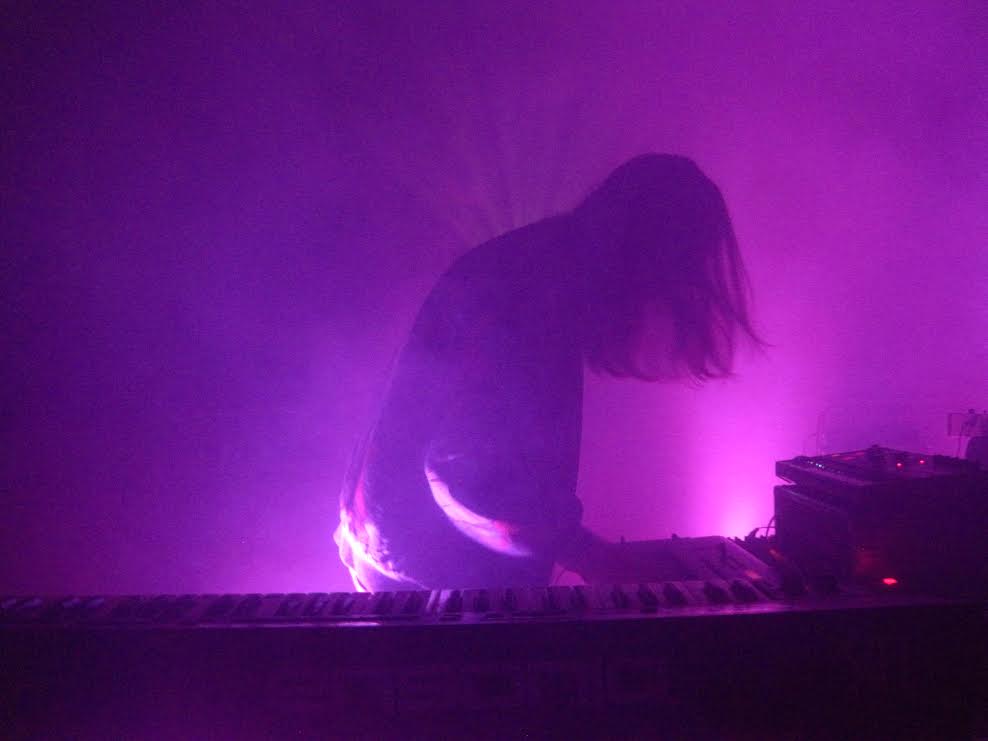
Photo by Rebecca Rose
JT: The album title Occlusions came about while I was in communication with Britt Brown from Not Not Fun. I was trying to pitch it as if it were sci-fi influenced. He suggested that we take our time with the album title. He was convinced that it was less of a sci-fi oriented album and more occult-influenced and explorative. As the release day was creeping up, we looked at the song titles, mostly Philip K. Dick references. The first track, “Occluded,” is an interesting word that implies being unable to see what’s right in front of you. You can be occluded from the truth. Even though Britt didn’t know it was a Philip K. Dick reference, he suggested we call the tape “Occluded” or “Occlusions.” I liked Occlusions.

JT: When we met, I was perusing the LPs at Sweat Records and I came across this obscure modular synth record, which appeared to be more like an academic exploration of modular synth. The album was called Occlusions! At first I was disappointed because I figured I’d have to redo the album title, and I was getting ready to e-mail Britt to relay the bad news, but then I thought maybe that was a sign for me. It started to make more sense that what I was feeling was the mystery. Maybe this was channeling something in my life that I hadn’t figured out. Maybe the music is an abstract interpretation of those mysteries. Through channeling those mysteries, maybe I can figure it out. I never told Britt about that album though (laughs).

JR: That’s really strange. I guess the sci-fi that I got out of it, and I think we discussed this when we met, is that it’s hard to think of sci-fi movies or, even beyond that, just movies of “the weird” without summoning John Carpenter. He’s sort of this overwhelming presence in how instrumental electronic music sounds and how horror/sci-fi movies look. Basically anyone doing that sparse, electronic instrumental music is automatically lumped in a little bit with him.

JT: Definitely. That’s what a lot of the comparisons that I’ve gotten have been. But even if I were to listen to a John Carpenter score or a Severed + Said album or an instrumental electronic artist, there are nuances. Maybe it sounds like a John Carpenter score that was never made. I understand the comparison. One of the keyboards that I use heavily is an early 90s Ensoniq. I actually just use the precuts because they sound so good. They sound like what I would hear from a John Carpenter film or that era of sci-fi/horror/David Lynch/Twin Peaks/Angelo Badalemente media.

JT: It has a lot to do with hardware. Those guys were using hardware rather than computers to make music, which is what people usually do now. But even on computers, the sounds emulate what was coming from those 80s keyboards. It may have to do with something more technical than someone trying to sound like that. But that’s great! I think John Carpenter is a better composer than a director anyway.

JR: Yeah, I think he’s more of the Stephen King of movies where the execution is secondary to the story. I mean, look, let’s put it this way: I’d never have anyone else direct a John Carpenter movie, but I’m not going to go into anything he’s directed with the expectation of understanding new things about film afterwards like you might when you see a Michel Haneke movie or a Kurosawa movie or a David Lynch movie or a Terence Mallick movie where you’re like “Holy Fuck! I didn’t know movies could do that.” But when I hear such an evocative and simultaneously cheesy soundtrack I can’t help but think it’s strangely effective and definitely new.

JT: And even without the film it stands alone. Like you said, it’s evocative: it can make you feel emotions even without seeing the context at times.

JR: Agreed. Anyway, how was your tour?

JT: It was good! we did eleven shows in eleven days. I don’t know if as many people would go as far as I did in such a short period of time. I didn’t want to book a long, extensive tour because I thought there was more risk of having to pay out of pocket. Matthew Moyer from PopNihil came with me, at first out of interest, but as I booked shows, there was room for him to play too. For the last month before I went on tour, I had provided backup sounds for Burnt Hair. We actually ended up putting Burnt Hair on three of the shows. He played in Athens, New York, and Savannah. I know he’s always wanted to play up North too so he got to fulfill that dream. It also meant that he wasn’t just tagging along, even though he had gladly signed up to just tag along.

JT: I really have to hand it to some of the promoters who were helping me out like Joe Mauro in Providence, who performs as New Bliss, called in a personal favor to Adam from Timeghost who played the Providence show. Craow played that show too - he’s another guy from Florida - along with New Bliss, and Mercy Gait, which is Ali from Power Monster. It was a really great show to be put on.

JT: I also got to play the Richmond, VA and Chapel Hill, NC dates with Holly Hunt and To Live & Shave in L.A. Tom Smith is such a nice guy and there's always Rat Bastard, who’s quiet, but has a strong presence. Additionally, there were two guys on tour with them: Graham from Atlanta who does Blossoming Noise Records and Patrick Spurlock. The last night of their tour was in Chapel Hill, which ended in an extended jam set between Holly Hunt and To Live & Shave in L.A.

JT: Barkev who does Bernard Hermann put the New York show on. We did it in the back of this bar called the Tandem Bar. It has a classic-looking back room area - seems like it may have been a popular cocaine bar in the 70s or 80s. That show was with Cienfuegos and a few others.

JT: Of course, there were a few shows that weren’t as well-attended. I can usually tell when the shows will be poorly attended if the people who are booking the show aren’t as communicative. The Atlanta show, for instance, was the first stop on the tour. I got in touch with what I guess is a fairly popular arts space called Mammal Gallery, but the guy I was in touch with expected me to round up the locals, which I did [laughs]. Matthew helped me get Death Domain on the lineup, which was awesome. There was no one there, but I played for Death Domain and Rin Larping, which is Lindsay Smith’s contact mic based experimental noise project.

JT: I also played in Dayton, Ohio, which is the only reason I went through Atlanta and Athens first. I’m sure you’re familiar with Dromez, which is Liz Gomez’s female-vocal based power electronics project. She used to be in Austin, TX. Her and her boyfriend John Maloney have a space together where they do intimate basement shows. She performed as her newer project Termagant - it’s more low tone, atmospheric, but still noisy and cacophonous. We got to hang out for breakfast the next day and she played me some unreleased Dromez stuff, which she described as more poppy than her other stuff, but I know it wouldn’t really qualify as pop music by any connection to the world.

JT: We also had all the costs covered too from tour. We didn’t make any money, but everything was covered.

JR: I feel like breaking even on a tour is a success.

JT: Yeah, me too. I realize how people can live life on the road. I’ve found that I wasn’t loafing off and spending money as I do in town while touring. I spend money when I don’t have something to do. It’s refreshing to see how that’s a viable, sustainable way to live. Selling merch, getting a little bit of money from the door, and putting it into gas and food.

JR: Did you sell many of your tapes?

JT: Yeah, I sold out of the ones that I had. I had forty of the Not Not Fun tapes and eighteen of the Crying in Dream tape from PopNihil. Some of them were traded for material. I would almost rather trade it because the person who gets it definitely wants the tape and I’m also getting something that I would like.

JR: I prefer to do things that way too. Record swaps. There are so many records that I really want to have. I’ll trade stock for them. I think that’s more fun and it’s a little anti-consumerist too: it proves that we can be a bit more collaborative in our society. There’s an element of hope in it too, I think. It’s a nicer way to have transactions.

JT: Yeah, it’s bartering. Maybe after the apocalypse, cassette tapes will be the new form of currency. And cassette players will be the ultimate commodity.

JR: I’ve got a walkman that I use all the time. That’s where I heard the Not Not Fun tape cause I can bring it to work when I’ve got office work. Actually, it’s how I heard the first PopNihil tape because when I first got to Miami, when we met, I was living in hotels and the only thing I had to listen to music was my walkman so I’d burn tapes all day. I listened to so many PopNihil tapes.

Photo by Rebecca Rose
JT: That’s awesome. I really like what PopNihil is doing. He must be getting close to his 60th release and he’s only been doing it for two years or less. He’s got a diverse catalogue too: he’s got obscure harsh noise, cinematic instrumental stuff, black metal, punk rock. As long as he keeps releasing the way that he has, PopNihil will continue to garner more respect and interest. I never met Matthew until I moved back to Jacksonville from California. Before I left, I put out a split tape with my last project Ascetic with Virgin Flower on another Florida label called Rainbow Pyramid. Matthew picked that up some time after I was gone. He knew that he wanted to put out Florida musicians. I’ve been doing music since I was a teenager, but I like to pretend most of those years didn’t happen (laughs). I’ve seen a lot of bad music and good music too that never got recorded or released. Since Matthew’s providing this outlet, at least some people will have their music documented. I’m really glad that my first release was on PopNihil, as far as Severed + Said goes. I remember when he came up to me after one of my first performances. I was just out of a long break up and because I had been in a band with that person, the band broke up too. After that break up I played the pre-INC show in Jacksonville of last year. Matthew was there and he came up after and said “I have dibs on your first release.” And, yeah, I was down. 

JT: It’s really only because of Ascetic, though, that I was put in touch with Not Not Fun. It was one of those things where Ascetic played a show in town after I moved back from California. And a guy at the show told me he really liked what we were doing and he told us a bunch of bands that he was interested in. I knew he wasn’t just a kook, but he didn’t necessarily have a ton of connections. And I was just like, “Yeah, whatever, dude.” So I sent him some stuff. And that guy got us in touch with Britt from Not Not Fun. We didn’t ever necessarily plan an official release, but we had a bunch of communication back and forth. Once we broke up though, there wasn’t really a reason to release anything. I never really e-mailed him back cause I was so disappointed. We had been working on material - in fact, all is done except for the vocals. After the PopNihil release, though, I sent him that and asked if he liked it. He didn’t confirm anything, but once I sent him the new material, he was stoked and we worked from October 2014 until the release date in May 2015.

JR: What do you have planned for the future?

JT: I have about twenty minutes of new material that I’m about to record. I talked to another band about doing a split and I talked to Britt about possibly releasing that split. I don’t want to say who or what cause I don’t want to jinx it, but I’m pretty sure there’s going to be a rad split coming out on Not Not Fun once I get my material recorded and once the other band gets their material recorded.


JT: For me, personally, other than that, I want to figure out how to do a set that I can travel more easily with. I want to minimize to the point where I’ll be able to fly somewhere to play. I’d love to go out to L.A. and promote some of my material from playing live shows. I have some friends in Oakland too and I’d love the play the venue Life Changing Ministries there - it’s a tiny church space that looks like a box with a small steeple. To avoid unwanted attention, they kept the name of the church and kept it looking like a church, but it’s actually a great experimental venue.

Friday, May 8, 2015

Interview with Joshua Touchton of Virgin Flower

There's this distinct moment from Joshua Touchton's International Noise Conference set as Virgin Flower where he bares his teeth and hisses in air. Is it a smile or a grimace? Does this gesture come from a place of exaltation and affirmation or pain and oppression? It's memorable because that idea of illusory context is an important one, not just to performance, but to our identities. Sure, a person mixes sounds together, but there's more to it. What lays the bedding of the mind that makes the sounds? Who watches the watchmen, dig?

I often don't get the answers, but one of the great joys of doing interviews with artists I respect and sometimes admire is getting glimpses of it. This is one such instance. I'm a bit honored to have gotten such an open response from Joshua about the darkness in his life surrounding his more recent output, including the excellent Absence of Essence on the consistently great PopNihil label, a swampy mix of beats, electronic samples, and distorted vocals, languishing somewhere between Suicide and Dr. Octagon.

The new tape is as much a reflection of Joshua's haunted past as it is his looking forward. Rather than stay trapped, Joshua casts out his darkness. The listener becomes witness. Does he or she empathize or dance along? Perhaps the two are not mutually exclusive.

Jordan Reyes: So tell me a little bit about the tape you just put out on PopNihil. That is your first tape, right?

Joshua Touchton: No, there was a tape I put out about two years ago on a Jacksonville label called Rainbow Pyramid. It was a split with my brother John in his previous band. She does the Mouth Mouth thing now. There were called Ascetic. We did a Virgin Flower/Ascetic split. This new release on PopNihil is, I don’t want to say more intimate, but it means a lot more to me.

JR: Why does it mean more?

JT: It’s all sample-based - I use a sampler, but the new samples were made from scratch. I use a drum machine and a synthesizer. The old samples were with a Synthesizer, an oscillator, and obscure tape samples. I feel like I found my niche now. I feel comfortable. I’ve developed a consistent sound. Since that tape, I’ve actually written a couple more songs and they’ve got a similar sound and feeling. So I’ve gotten out of that last phase and begun to do what I’ve always wanted to do by myself. I feel like the new Virgin Flower tape is an extension of a band my brother and I used to be in, which was a heavy noise rock n’ roll band. I played drums and he played guitar and synth. Where we left off, I picked up. It’s noise punk rock by one man.

JT: I like the previous tape a lot too, though. That’s why I kept the name. It’s out there on the internet. Actually, I also did a split with Baby Ghost on PopNihil so there was another previous Virgin Flower PopNihil release that had two songs of mine on it. It’s a really short split - about twelve or fourteen minutes altogether.

JR: Have you known Matthew for a long time?

JT: Yeah, I’ve known him since 2012 I believe. We’re going on three years of knowing each other.

JR: Are you and your brother John [editor’s note: John Touchton from Severed + Said] close? Do you guys get to bounce ideas off each other?

JT: Yeah, well, outside of being my brother, John’s my best friend. He’s definitely someone that I’m influenced by greatly. We live and work together and have made music for a long time. I actually just bought some drum sticks today and we played music for the first time in a long time. We’ll play electronic stuff together too. But in terms of bouncing ideas, totally. I ask him questions and he asks me questions. I would say we’re both inspired by each other, though I can obviously only speak for myself.

JT: Beyond an artistic level, on a personal level, I think he’s a really good person. I like what he does. I think he’s smart.

JR: I really enjoy talking to him too. I met him at Sweat the night after you played and we ended up talking about Philip K. Dick for like half an hour. It was awesome.

JT: He’s a smart dude and I’m inspired by the way he lives. He lives a very balanced life, I’d say. He’s helped me when I’ve been in fucked up places. There’s a couple people who have helped me through some crazy shit. I’m glad to have had that come around. I can’t imagine what my life would be like if we hadn’t grown up together or what his would be like.

JR: So what was your first encounter with experimental, darker, noisier music?

JT: I’d say when I was about fifteen I saw and met these dudes Chris Spohn and Logan Owlbeemoth. They would do Telepathic Friend and Friendless Outsider. Logan has gone to form Os Ovni. I don’t keep in contact with either of those dudes anymore. So that was in 2005 to answer your question. A lot of the older noise, experimental dudes I got into are either totally burnt out or very competitive and afraid of other creative outlets, afraid of other people having success. A lot of the noise dudes are really fucking strange, man. They’re burnt out or isolated or weird internet dudes.

JT: So in 2005, I saw some more experimental projects at this place The Pit in Jacksonville. There were two pits. One was an outside DIY space and a lot of good bands came through there. Thank God came through there. Upside Down Cross. Wolf Dick. Super Pizza Party. Telepathic Friend.

JT: Before that, I was into punk music, but I found out about Suicide when I was about thirteen. I remember seeing “Dream, Baby, Dream” and thinking “this is fucked up.” Seeing that, I recognized it as something that I related to that wasn’t full-on punk rock. Ultimately I feel like that stuff affects the way I make music. I sound like some mix of electronic punk and I’m really excited that I have people like Matthew and John to encourage me to do what I’ve been doing.

JT: Jacksonville is a weird place to play experimental shows at. I don’t play out that much because it’s not worth it sometimes. I like going out of town to play.

JR: That’s what I was going to ask next, like, how is Jacksonville for an artist like you?

JT: It’s great in the sense that there are a lot of creators here doing experimental stuff. Matthew, John, and a couple other people are a steady foundation for that. But the people who go to shows here seem to be less concerned with the cultural aspect. They’ll just go out with no intention to hear music. There’s a lot of that. That’s okay. That’s better than no one being there, but I feel like most of what’s going on here isn’t thought of the same way that I think of it. But I believe in what we’re doing and I believe in Jacksonville. I love Jacksonville, though. I would move if I weren’t happy here.

JT: There’s exchange too. There’s a lot of hardcore here, but maybe that’s everywhere. There’s a lack of punk rock, though. There’s not a lack of experimental stuff, but there’s not that much support. At the same time, you have people like Matthew who’s doing something special. He’s the dude and his fucking label has put out so many releases in two years.

JR: I can’t believe how much he’s done.

JT: He’s an impressive dude as far as that goes. I think Jacksonville is on its way up. I think people are going to recognize what’s going on here. Maybe not, but we’d all be doing stuff even without the recognition. John just got that release on Not Not Fun for Severed + Said too. That’s a really big deal. I’m really proud and happy for him. 

JR: That’s massive. I guess he’s doing a East Coast tour soon too.

JT: I think Matthew’s going with him. I don’t know if he’s going to play any shows, but I know he’s going with John. That’s good news for anyone who releases a tape with Matthew - he’s going to go out of his way to help people on his label.

JR: Have you gotten much response for the tape?

JT: To be honest, not yet. There’s a lot of people I personally know who gave me some. I couldn’t be happier, but I don’t think too many people have bought the tape at this point - I don’t think it’s sold out. I’m kind of happy, though. I don’t want a bunch of locals owning it. I don’t want to waste copies on people that I already know or something. I’m keeping all of my copies - I mean, I’ve given it to a few important people. I told most of my friends who want it to either order from Matthew or listen to it on the internet. It’s really special to me.

JT: So this is the most response I’ve gotten - from you and some dudes from Orlando who have asked Matthew to book me there. Like I said, I’m releasing music for response, but whether or not I get any sort of response doesn’t keep me from doing what I’m doing. I don’t do music to be popular or to get credited. I like people hearing it. I want people to, but I think it’s more of an outlet or a therapy than anything. It’s my journal. It’s my exegesis (laughs).

JR: A lot of your vocals are pretty distorted on the tape. What are you talking about?

JT: Most of it is about self-obsession, negative desires, drug addiction. My last few years were very intense. I stopped making music for a while. I put a lid on some things and started doing music again. All the music I’ve made since then has been about the last two years of my self-obsession, physical and psychological abuse, self-destruction. I mean - it was just a really rough couple of years. There’s a lot about hard drugs, being alone, and being happy with everything I was doing, living only for my desires, and being okay with that. Now I’m not. I’m still sick in a lot of ways, but not in the way I was. There’s no hard drugs now besides alcohol.

JT: That description sounds dark, but to me what’s truly dark is poppy music with the same concept. At least when you put on headphones and listen you know it’s dark. There’s no subliminal message. It’s obvious by the packaging and style of music. It’s still poppy in a way. There’s still a beat to it.

JR: I think a lot of pop music isn’t just dark but it tells people to embrace a lifestyle prepared to make you an unhappy person.

JT: Definitely. That’s what I’m saying. I had this conversation with a dude Genre Baptiste. His shit’s really catchy and amazing. I love it. I saw him in St. Augustine and got to meet him so I told him “Wow, that was great. It was really dark.” And he said “No, it’s not dark. It’s poppy.” And I was like “Yeah, it’s poppy and catchy but your subject matter has so much discontent that I can relate to.” I felt like he slipped it in and covered it up behind a poppy song. So, yeah, I completely agree with you. All these songs on the radio that are scientifically going to make you dance, where there’s no way you can hate the chord progression, has a message that’s “Get drunk and fuck. Get fucked up and fuck.” To me, that’s way more dark than what I’m doing. My shit’s obvious. It’s obviously about an outlet for the dark sides of myself.

JR: It’s sort of like, this is maybe a weird way to put it, it’s what the devil from Christianity would do. It’s that sick-smelling honey that brings you close and ends up making you ill.

JT: That’s a good way to put it. It takes the negative things that you’re told not to do or be careful in doing and making them appealing. To me, that’s the darkest shit ever. I covered a Backstreet Boys song a couple years ago. My intention was to show how to how that culture is a distraction and negative for girls, urban girls, or whatever. It’s telling you to go to a mall and get a dress and new jeans. It takes all the industries of the world and tries to destroy culture. Any threatening culture out there they try to neutralize as quickly as possible.
JT: Pop music is down to a science. The frequencies and chord progressions are things you can’t dislike. Underneath that is an undertone of darkness that, if you thought was the secret answer, would cause you to hate your life and potentially die from being too intoxicated or getting an STD.

JR: But it also make you consume. It makes you buy. You begin thinking “I could do the same thing as these guys if I buy the right car or if I look the right way.” And everyone is in on it together and it’s totally terrifying.

JT: You’re right. And it’s terrifying that sometimes the jobs we have, which we need to live, leaves us with a certain amount of money that we don’t spend on bills. I know that I’ll be bored and go spend money that I have on something, or go out to eat. Buying something because I’m unhappy or have an impulse. They got to me. I like to think of myself as being on a minimal level of that idea, but we’re all stuck in this cycle of work, which gives you extra money and you have two days off on the weekend - what are you going to do? Will you spend it on drinking or buying shit? They’ve got me where they want me.


JT: But I also don’t have a car. I like to think of myself as being on a lesser level, but I like to buy cigarettes or alcohol. I don’t buy any drugs that come from gas or have blood on them. Being a consumer is a real thing, and it’s been going on since we were children, or even infants. They’ve been trying to get us and they did. It’ll be okay (laughs).

Sunday, April 19, 2015

Interview with Alexandra Pharmakidis of Power Monster

Dissonance is a human concept, though largely an elusive one. The same notes that might sound out of place on a European piano piece might be perfectly tailored to a Japanese folk song on the shamisen. "Noise" as we think of it today has always existed, though it has not always been recorded. I briefly likened the sound of power electronics and noise to the great and terrible forces of nature in my interview with Jim Haras of Deterge and it's true - a good noise show transfers sublimity onto the listener like the sound of a dozen redwoods falling in unity. In Edmund Burke's A Philosophical Inquiry into the Origin of our Ideas of the Sublime and Beautiful, Burke talks about beauty as something that fits nicely into a form, like the gentle neck of a swan or the notes and harmonies of Handel's "Messiah." The sublime is something formless and unknowable. As far as sublimity in recorded music goes, I'd argue that while classical, baroque, and jazz can be sublime in grandiosity, the form in which the substance fits still languish in the Romantic idea of beauty. I think of the scores behind Fritz Lang's films as being both sublime and beautiful - obviously the visuals have something to do with the music being sublime, but it's not experimental or unexpected and at the bottom of everything, it's still nice.

When people like John Cage and Karlheinz Stockhausen began putting their mark on instrumental music, things began to get sublime as fuck and F-A-S-T. This trajectory of music as an unwelcome, nebulous, possibly destructive and monstrous force has continued to evolve through the 80s and 90s when artists like Incapacitants, Hijokaidan, Whitehouse, Merzbow, Atrax Morgue, Genocide Organ, MSBR, and Maurizio Bianchi did their best to keep the train moving-right-along.  All aboard the abstruse caboose.

Except now there are people who listen to noise. People are no longer shocked by noise. And sometimes noise fits nicely into a "noise form." So does that make it beautiful? Does that cheapen its effect? Does noise become both priest and heretic to its message?

Doesn't matter, but it's a cool thought exercise. If you listen to noise or are new to its call, Alexandra Pharmakidis' solo project Power Monster can be both sublime and beautiful. To the untrained listener, it can seem overwhelming, but it's also the sound of transcendence. Occasionally, Ali's vocals break through the static. The listener leans in to hear what secrets emerge from the small hole in the wall only to find the opening to have changed positions. It's a give and take interaction. The listener puts in what he or she will take out. I find that I enjoy reading while listening - for me, Ali's music has crossed the threshold of harsh into calming, meditative. The world takes all kinds.

Give her new tape on PopNihil a listen and a pick up on their bandcamp page

Jordan Reyes: The PopNihil cassette is actually the first Power Monster release that I own but I’ve heard your stuff online before. I was looking at the track listing and a lot of the songs seem very existential, conscious-based. Do you think about that a lot?

Alexandra Pharmakidis: Oh yeah. Constantly. It’s hard for me to stop, which can be exhausting. Working on noise gives the thoughts directions so they’re not just stewing in my brain.

Photo by Gyna Bootleg
JR: I couldn’t really make out the vocals on your tape What do you talk about?

AP: That’s a conscious thing. I like the vocals to be buried, chopped up, and as difficult as the rest of the music is. I feel like some of my lyrics are so goofy or personal. I’m pretty shy so it is hard for me to let them out and be heard for what they are.

JR: Why would you choose to put in lyrics if it’s so uncomfortable?

AP: I just feel driven to get those thoughts and emotions out: to release that tension and anxiety rather than holding it in all the time. That’s not really healthy.

JR: Is that why you sought out and decided to do noise?

AP: Well, I’ve been drawn to noise and experimental music for a really long time. I find creating it compelling. There’s no boundaries with noise: you can make it with anything - any kind of gear or trash and endlessly manipulate it digitally. That’s very meditative for me. I can do it for hours and hours and hours. I can read music and plunk out a tune on the keyboard. My piano teacher when I was eight actually told my mother to give up on me.

JR: Oh my gosh!

AP: Apparently the talent just wasn’t there.

JR: Wow, that’s like super cruel!

AP: Yeah. (laughs). And I have some minor nerve damage that affects my right hand so I can’t play traditional instruments as much as I might like to.

JR: Do you mind me asking what happened?

AP: No, that’s no problem. About two years ago I woke up and my right hand was numb. I thought it was Carpal-Tunnel at first, but I realized that the numbness was spreading up my arm and going down my body. It got to the point where I couldn’t make a fist. It turned out to be an inflammation of nerves in my spine that was affecting my hands. It’s much better now, but they still don’t know what caused it.

JR: Did you have to get surgery?

AP: They gave me steroids to bring down the inflammation, I got acupuncture, and then there was physical and occupational therapy to rebuild the muscles in my hands. The sensation in my hand is about 75% of what it was. That’s what it will probably stay at.

JR: Wow, that’s terrifying. I’ve never had anything like that happen. I’ve had a lot of injuries, but they’ve all been from doing stupid things. The idea of not having control over something that’s so physically affecting has got to be unsettling.

AP: It was and is. It was a rough few months right before I moved from Austin, TX.

JR: I didn’t know you were from Austin.

AP: I grew up in Providence, but I lived in Austin for about eleven years.

JR: Why the move?

Photo by Gyna Bootleg
AP: Oh no. It was because I had 50K in medical debt (laughs). I couldn’t use my hand so I lost my job. I got really depressed. My boyfriend broke up with me.

JR: That’s super rough.

AP: I was originally intending on moving back to Austin, but it’s gotten so expensive there and gentrified. It’s a completely different beast than the city I moved to. I decided to stay in Providence and put down roots, which I think was a good decision.


JR: I’ve never been to Texas or Providence. I’ve been to a lot of places around the country because I drive a lot. That’s meditative for me. One day. Does noise give you a sense of control when you play or make music?

AP: When I’m working on tracks and recording absolutely. When I’m playing live, it’s almost completely the opposite. I know I have a good set if I sort of black out. I go to another place, really. I’ll have to watch the video later to see what it sounded like and what actually happened.

JR: Do you get that sensation frequently?

AP: Pretty much every time I play unless it’s a really bad set when I’m tense, nervous and concentrating on everything too much. That’s usually when things go wrong and I remember every excruciating detail.

JR: Is there a ritual to gear your mind into that place?

AP: Not really. I try to have a couple beers before I play. Any more and I’ll be sloppy. Any less and I’ll be too tense. Then just making sure I can set up as early as possible so I know everything works and I know where my levels are. I hate having to set up right before I play and getting to check. I don’t like having people waiting around while I’m plugging in cables.

JR: I hear you. I do sort of a dark folk thing and I just have my acoustic guitar, a pick up, a couple pedals, an amp and I don’t have to check anything. When I’ve seen people prepare for noise it’s very, very intensive. It can take as long as the set.

AP: Yeah, yeah, it definitely can. And gear malfunctions are par for the course. I recently played at AS220 here in Providence. I don’t know how much you know about gear in noise, but I had a DOD Buzzbox, which is a highly coveted pedal by some noise artists because they don’t make them anymore. It’s gone through so much abuse that the shell has actually crumbled. I was testing it out, turning it off and on, and it literally fell to bits on the table. I had a little bit of a meltdown (laughs). I was checking Ebay and one in mint condition goes for about $300, which is not quite in my budget right now.

JR: That’s a ton of money. So, to answer your question - I don’t know that much about noise equipment - I know how things work in terms of circuitry but I don’t have any sort of mental catalogue of pedals. I would just know what makes what sound it would make if you told me what it was and how everything works together. When you do noise, you do have to know all these pedals though, right?

Photo by Gyna Bootleg
AP: Pretty much. I’ve spent many, many nights on wikipedia and pedal forum k-holes reading up on stuff because I’m always looking to change my set up a little bit. What tweaks can I do to make the sound more full? I read about pedals and gear a lot. By comparison, I’m not even a gear nerd (laughs).

JR: Do you think people are generally collaborative and willing to help when you have questions?

AP: Oh yeah. The noise community is an open, friendly place. A lot of the imagery is foreboding - lots of sex and violence, but most of the people involved are the nicest people that you could get to meet. There are lots of people who will answer any questions you might have about gear, or tell you where to go to get gear repaired or get new gear. There’s also noise forums for that. In comparison to some people, I’m not a big gear nerd. I don’t even have that big of a set up.

JR: What does “not that big of a set up” mean?

AP: (Laughs) It means my live set up is two pedal chains and a contact mic. I don’t have multiple synths or chains of twenty pedals or anything like that.

JR: The only noise I’ve really made is with people manipulating my guitar sound or using my electric guitar as a more percussive instrument.

AP: That’s actually something I used to do in a project I was in called Sex Bruises. It was kind of guitar rape (laughs).

JR: That’s really vivid (laughs). I think using things atypically is always interesting. So what was your first noise project?

AP: I had been messing around with noise without calling it a “project” for a long time. In my storage space in Austin, I have tapes going back to the early 2000s but I didn’t really have like a “project.” I was too shy to even name it! So Power Monster is my first solo project and then in Texas I was in a number of different projects. Sex Bruises was a duo project I was in with  Matt LaComette. I was also in Mucophagia, which is a really dorky name (laughs).

JR: I have no idea what that means.

AP: It’s the medical term for the compulsion to eat your own snot (laughs). That was me, Matt LaComette, and Johnny Cash. There were a few others. When I moved to Providence, I didn’t really know anyone when I first got here because I hadn’t lived here in years. I really went for putting out as much Power Monster material as possible. It was really the first chance I had had in a while to concentrate just on that.

JR: What ideas do you try to get across in Power Monster as opposed to in a group?

Photo by Gyna Bootleg
AP: That’s a hard one because it’s so abstract. It varies from release to release. I did a release last winter on Altar of Waste, which is a CD-R label out of Minneapolis called Love is a Lie and that was obviously an angry post-break-up thing because I had that to get out (laughs). I did another on the same label called Leviticus, which was me reflecting on religion and how women are just held down globally by it and have been for centuries. I have addressed the issue of being a female in noise because that is kind of an anomaly. It’s easy, I think, to go on a feminist diatribe about how it’s not fair that there aren’t enough women in music, et cetera, et cetera. It’s really easy to do something like that. It’s much harder and cathartic to put yourself out there and start making things and releasing things. People will pay attention.

JR: Absolutely. I was talking to my friend Lauren [Bach] in Chicago. I just moved to Miami and honestly just got an apartment last week (laughs) so it’s been very recent. She was a bit taken aback by the pressure for women power electronics artists to become this overly-sexualized woman. Both of us didn’t think that a woman should have to play into this trope and be objectified or let yourself be objectified to have success in noise. I think everyone should be able to do what they want, but it does make me feel a bit disheartened to see that as being the reason behind female noise musicians' success - being exactly what every noise nerd wants to see.

AP: Oh yeah. I’ve definitely used images of my own body on my tapes and releases. I have no shame about it. I used to get really annoyed about noise releases that had porn on them. You see that a lot, especially on 90s Japanoise tapes. It's just been done so much. It really bugs me. Someone asked me “What’s the difference? You’re putting your body out on display.” But it’s me. It’s not just some girl cut up from a magazine who has no idea it’s happening. I can express myself however I damn well please.

JR: There’s a difference between affirmation and exploitation too.

AP: For sure. And I don’t feel like I’m exploiting myself by doing that.

JR: I couldn’t help but read on your Facebook page that some shop refused to print some of the J-cards for the PopNihil release.

AP: Yeah! They printed part of it, but then they stopped! That was highly amusing. It wasn’t that big of a deal. Matthew Moyer, who runs PopNihil and is the nicest guy, just asked around “Where do the punks in town get their fliers printed? Okay, I’ll go there.” and he just went there and they printed them without even batting an eye.

JR: Yeah. He’s a total sweetheart. I met him one of the first weekends I moved down here at the International Noise Conference and we were kindred spirits almost immediately. But yeah, that was a bit funny to hear. Do you have any other Power Monster releases or shows coming up?

AP: Yeah! I’m going to be doing a release for Signora Ward Records - they’re a tape label in Italy. Omar from Rectal Hygienics asked me to do something for Depravity Label. Matthew Moyer is interested in doing a tape for a project I’m in called Mercy Gait, which is me and my friend Steph who used to be in Tinsel Teeth. That’s sort of a bondage noise project. We build contact mics into bondage gear. We have a few shows coming up on May 5th and June 1st. And then there’s a Power Monster show at the end of the month here in Providence.

Friday, March 20, 2015

Release of the Day: Into The Thicket - Dark Night of the Soul

Ritual is a bit of a loaded term. Alone, it doesn't mean much other than "a repeatable instance" but it can take on much greater spiritual, metaphysical tones or become low, conniving, and greedy.To begin, let's think about the Casino. A professional gambler may go through the ritual of blowing on dice, wearing glasses to the poker table, ordering the same drink with each hand, all done in serving the god of chance. A baseball enthusiast might wear a "lucky hat" to a game to invoke the god of sport. A priest in a Catholic church goes through ritual upon ritual in schooling in order to eventually perfect the rituals of sacrament and performance in worship of the Christian God.

But ritual is also not a snap. It is the preparation for the harbinger and its eventual fruition. To bring us closer to the idea of Into The Thicket, in Chaos Magick, the magician starves him or herself, prepares his or her magickal weapon, takes hallucinogenic drugs, deprives him or herself of sleep, and prepares the olfactory, visual, and auditory aids to summon a spirit or demon. Through disorientation and provocation, a monster tears through the veil. I can't say that I've seen Into the Thicket engage in one of their recording rituals, but judging from their music, and the few pictures and videos I've seen, I imagine that I'm not too far off in thinking they may have some knowledge of the aforementioned practices.

Into the Thicket makes ritual industrial music using the bones of animals, electronics, and more. But there is a vision too that certainly has a lot to do with their locale. The group comes from (and lives in) the Florida swamp, encumbered by its miasma and distaste for "civilization." This isn't to say that the music is unwieldy, but rather that CT Corrigan and Ryan Debile are familiar with the idea of nature's dominance and know how to engage it and appeal to it. Rather than be afraid of the sublime, Into the Thicket takes the role of the shaman, channeling it, which is ultimately where the release gets its power.